
Smoked Porchetta Recipe: Crispy, Juicy, and Bold
Ingredients
Method
- DRY BRINE THE SKIN THE NIGHT BEFORE: Lay your pork belly skin-side up on a wire rack set over a sheet pan. Using a sharp knife, score the skin in a tight crosshatch pattern, cutting through the skin and just barely into the fat layer underneath. Make your cuts about half an inch apart. Mix 1 tablespoon of kosher salt with 1 teaspoon of baking powder and rub this mixture all over the scored skin. Do not rub it on the flesh side yet. Leave the pork belly uncovered in the refrigerator overnight, or for a minimum of 8 hours. The salt draws moisture out of the skin cells and the baking powder raises the pH to promote better browning and crackling. This step is what separates a great porchetta from a truly elite one.
- MAKE THE HERB PASTE: The next day, combine the minced garlic, rosemary, sage, thyme, crushed fennel seeds, fennel pollen if using, red pepper flakes, lemon zest, 2 tablespoons of olive oil, 2 teaspoons of kosher salt, and black pepper in a small bowl. Stir everything together into a thick, fragrant paste. Taste it. It should be bold, garlicky, herbaceous, and slightly spicy. Adjust seasoning as needed. This paste is the soul of your porchetta, so do not be shy with the flavors.
- BUILD THE ROLL: Remove the pork belly from the refrigerator and flip it flesh-side up. Pat the flesh side dry with paper towels. Lay the pork loin down the center of the belly. Spread the herb paste aggressively over the entire flesh side of the belly and coat all sides of the loin as well. Now roll the belly tightly around the loin, starting from the long edge closest to you. The skin should end up on the outside of the roll. Pull it snug as you go. Once rolled, tie it tightly with butcher twine at 1.5-inch intervals along the entire length. The roll should be firm and hold its cylindrical shape without sagging. Brush the outside of the skin lightly with the remaining tablespoon of olive oil and sprinkle on a little extra kosher salt.
- FIRE UP THE SMOKER: Set up your smoker or grill for indirect heat and bring the chamber temperature to a steady 250 degrees Fahrenheit. If you are using a kettle grill, bank your coals to one side and set a drip pan on the other side under where the roast will sit. Place your hardwood chunks directly on the coals or in the firebox. Wait until you see thin blue smoke coming from the vents, not thick white billowing smoke. Thin blue smoke is clean smoke and that is exactly what you want penetrating your porchetta. Thick white smoke will make it taste acrid and bitter.
- SMOKE LOW AND SLOW: Place the porchetta roll seam-side down on the grill grate over indirect heat. Insert your leave-in probe thermometer into the thickest part of the center, making sure you are hitting the pork loin and not a pocket of fat or herb filling. Close the lid and let it smoke undisturbed at 250 degrees Fahrenheit. Resist the urge to open the lid constantly. Every time you open the lid you lose 15 to 20 minutes of steady cook time. Check your fire every 45 minutes to make sure the temperature is holding. Add a small amount of charcoal if needed. At the 2-hour mark, rotate the roll 180 degrees to ensure even cooking. You are looking for a deep mahogany exterior and a smoke ring forming around the outer edge of the meat.
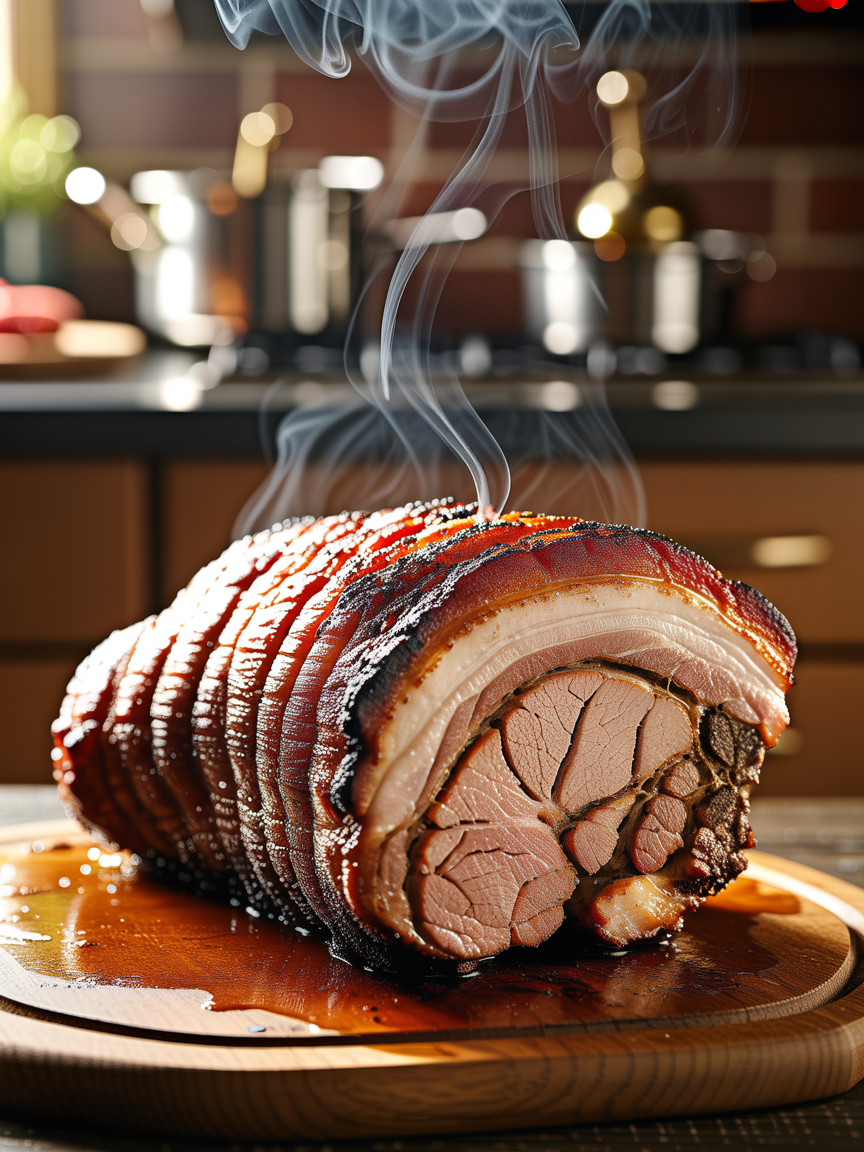
- MONITOR THE INTERNAL TEMP: Continue smoking at 250 degrees Fahrenheit until the internal temp of the pork loin center reaches 135 degrees Fahrenheit. This is your target for moving into the high-heat finish phase. Depending on the size of your roll and the consistency of your fire, this will take approximately 3 to 3.5 hours. The fat will be rendering beautifully at this stage, the herb paste will have melded into a gorgeous dark crust, and your backyard will smell absolutely incredible.
- THE HIGH-HEAT CRACKLING BLAST: When the internal temp hits 135 degrees Fahrenheit, it is time to crank the heat. Open your vents wide and if possible, add a small chimney of fresh lit coals to boost your chamber temp up to 450 to 500 degrees Fahrenheit. If you are on a gas grill, turn all burners to high for this phase. Alternatively, you can finish the porchetta in a preheated oven at 500 degrees Fahrenheit for 20 to 25 minutes if getting your smoker that hot is difficult. The goal here is rapid, intense heat that blisters and puffs the scored skin into shatteringly crispy crackling. Rotate the roll every 5 to 7 minutes so all sides of the skin get hit with direct high heat. You will hear it sizzling and popping and that is the sound of pure perfection.
- PULL AND REST THE MEAT: Pull the porchetta off the heat when the internal temp hits 145 degrees Fahrenheit. This is the USDA-safe temperature for whole muscle pork and it will carry over a few degrees during the rest. Transfer it to a clean cutting board and tent it loosely with foil. Let it rest the meat for a minimum of 20 to 25 minutes. Do not skip this step. The rest allows the juices that have been driven toward the center during cooking to redistribute back through the entire roast. If you cut into it too early, all those beautiful juices run out onto the cutting board instead of staying in the meat where they belong.
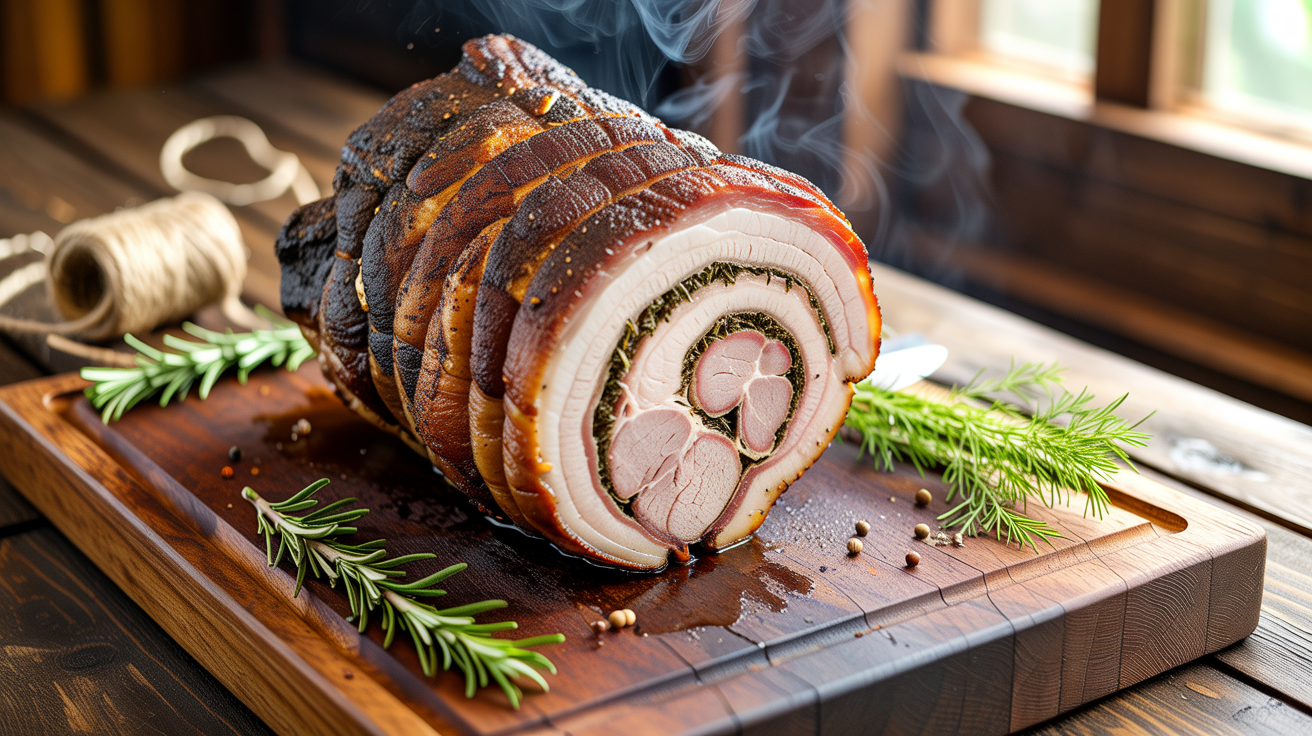
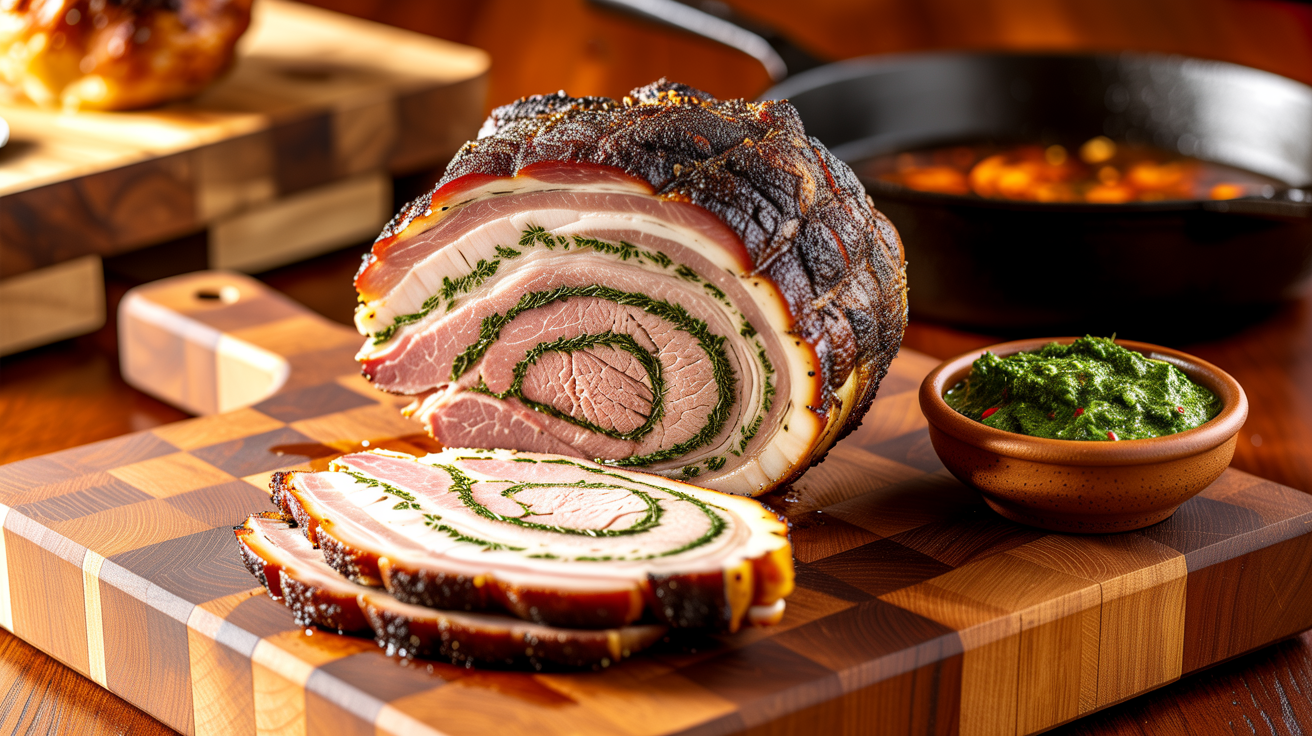
- CARVE AND SERVE: Remove the butcher twine before carving. Use a sharp slicing knife and cut the porchetta into rounds that are about 1-inch thick. Every slice should show a spiral of herb-flecked pork belly surrounding a juicy center of loin, ringed by that deep smoke-kissed bark, all enclosed in a band of crispy crackling skin. Serve immediately on a wooden cutting board with crusty bread, roasted vegetables, or a sharp chimichurri. Stand back and accept the compliments you have absolutely earned.
Nutrition
This smoked porchetta recipe takes one of the most celebrated roasts in Italian culinary tradition and runs it straight through the smoker for a result that is nothing short of legendary. We are talking a skin-on pork belly wrapped around a pork loin, packed with fennel, garlic, rosemary, and lemon zest, then tied tight and smoked low and slow over fragrant hardwood until that skin turns into pure crackling perfection. If you have ever wanted to be the undisputed hero of your backyard cookout, this is your moment.
The magic of smoking porchetta lies in the two-phase cook. You start low at around 250 degrees Fahrenheit to render the fat, build a gorgeous smoke ring, and let those herby aromatics penetrate deep into the meat. Then you crank the heat at the end to blast that skin into blistered, crispy heaven. We are chasing an internal temp of 145 degrees Fahrenheit in the center of the loin before we even think about pulling it off the smoker. The bark that develops on the outside is earthy, herbal, and slightly sweet from the wood smoke, a combination that will have your guests completely speechless.
Do not let the size of this cook intimidate you. Yes, it takes a few hours. Yes, you need to score the skin and truss the roll with butcher twine. But every single step is straightforward, and the payoff is one of the most impressive things you will ever carve at a backyard table. Whether you are running a dedicated offset smoker, a kettle grill with a two-zone setup, or a ceramic kamado, this smoked porchetta recipe works beautifully across every setup. Get your fire dialed in, and let us get rolling.
Smoked Porchetta Recipe: Crispy, Juicy, and Bold
This smoked porchetta recipe delivers an Italian classic with a serious BBQ upgrade. Rolled with fresh herbs, slow-smoked to perfection, and finished with shatteringly crispy skin, this centerpiece roast is the kind of cook that makes the whole neighborhood jealous. Fire up the grill today.
Ingredients
| AMOUNT | INGREDIENT | NOTES |
|---|---|---|
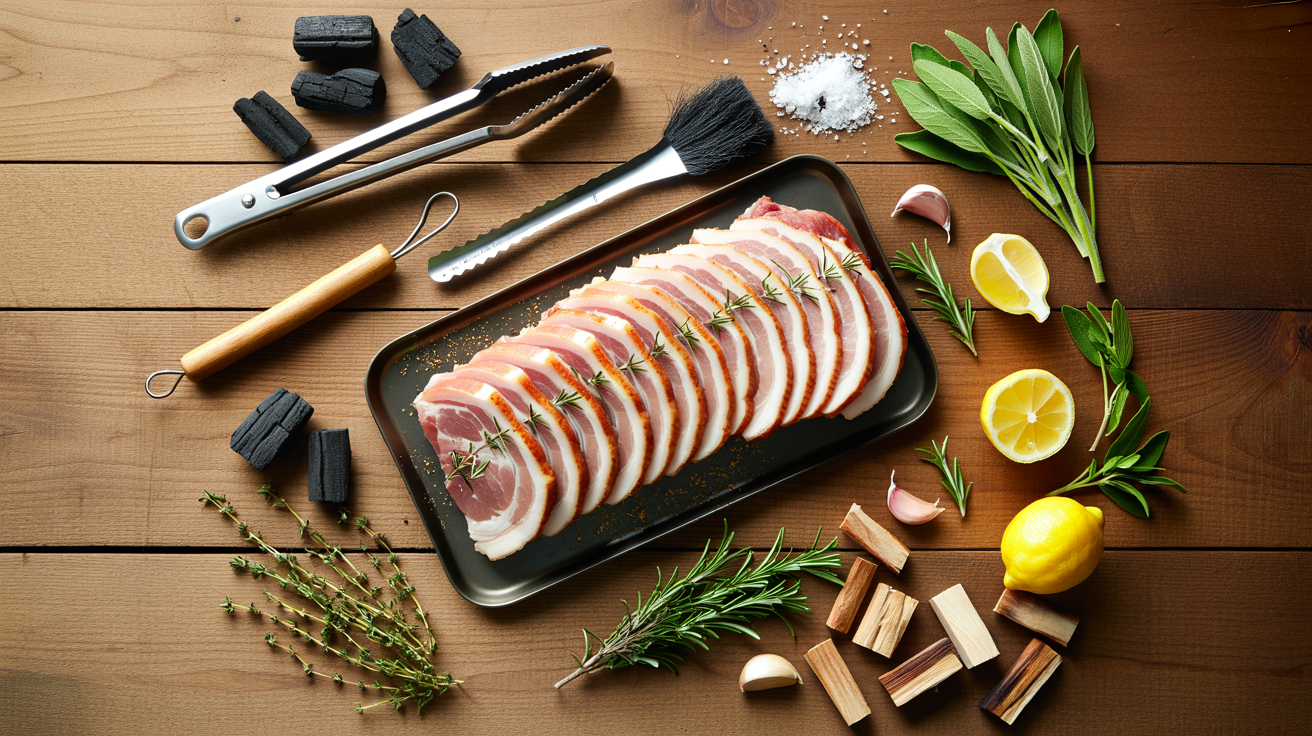
| 1 | skin-on pork belly slab, about 4 to 5 lbs and roughly 12-inch by 14-inch | ask your butcher for a flat, even-thickness slab with the skin fully intact |
| 1 lb | center-cut pork loin | trimmed of silver skin, butterflied open if thicker than 2 inches |
| 8 cloves | garlic | finely minced or pressed into a paste |
| 2 tablespoons | fresh rosemary leaves | finely chopped |
| 2 tablespoons | fresh sage leaves | finely chopped |
| 1 tablespoon | fresh thyme leaves | stripped from stems |
| 1 tablespoon | fennel seeds | toasted and coarsely crushed in a mortar and pestle |
| 1 teaspoon | fennel pollen | optional but highly recommended for authentic flavor |
| 1 tablespoon | red pepper flakes | adjust to your heat preference |
| 2 teaspoons | coarse kosher salt | for the herb filling |
| 1 teaspoon | freshly ground black pepper | for the herb filling |
| 1 | lemon, zest only | bright citrus note that cuts through the richness of the pork belly |
| 3 tablespoons | extra virgin olive oil | divided, for the filling and for finishing the exterior |
| 1 tablespoon | kosher salt | for dry brining the skin overnight |
| 1 teaspoon | baking powder | mixed with skin salt, helps draw out moisture for maximum crackling |
| 2 large | applewood or cherrywood chunks | for smoking, not chips |
Instructions
Nutrition (per serving)
The BBQ Story Behind This Recipe
Porchetta is a dish that traces its roots back centuries in central Italy, particularly in the Lazio and Umbria regions where whole roasted pigs have been a festivity staple since at least the medieval period. The town of Ariccia in the Castelli Romani hills near Rome is widely considered the spiritual home of porchetta, where roadside stalls have been selling thick slices stuffed into crusty bread rolls for generations. Traditionally cooked in wood-fired ovens over an open flame, the dish was born out of a culture that deeply understood the relationship between fire, fat, and flavor. The classic Italian version uses wild fennel pollen, garlic, rosemary, and black pepper, all layered into a deboned whole pig that is roasted until the skin crackles like glass.
In the American BBQ world, porchetta found a natural second home the moment pitmasters realized that the same principles driving great slow-cooked pork shoulders and briskets applied perfectly to this rolled Italian roast. The smoke adds a dimension that wood-fired oven cooking approximates but never quite matches in the same way. American BBQ culture latched onto the pork belly and loin combination as an accessible format, turning a once-exotic Italian street food into a legitimate contender on the competition circuit and the weekend backyard scene alike. Today, smoked porchetta sits confidently at the crossroads of old-world Italian craft and new-world BBQ obsession, representing the very best of what happens when two great fire-cooking traditions come together.
Hot Off the Grill
A Closer Look
Pitmaster Tips for Best Results
- Do not skip the overnight dry brine on the skin. That combination of kosher salt and baking powder is the secret weapon for crackling. At minimum, give it 8 full hours uncovered in the fridge. The drier that skin surface is going into the smoker, the more violent and satisfying the crackling will be during the high-heat finish.
- Use thin blue smoke, not heavy white smoke. Load your wood chunks before the meat goes on and wait until the smoke runs thin and nearly invisible or faintly blue before placing the porchetta. Fruitwoods like apple or cherry burn clean and complement the herbal filling without overpowering it. Two chunks is enough for the entire cook.
- Tie the roll tighter than you think is necessary. A loose porchetta roll will sag, cook unevenly, and lose its filling. Space your butcher twine ties at 1.5-inch intervals and pull each one snug before knotting. A tight, firm cylinder cooks more evenly and produces cleaner slices.
- If the skin is not crackling during the high-heat phase, use a kitchen torch to hit any stubborn spots directly. A handheld propane torch lets you target specific sections of skin that need an extra blast without overcooking the meat underneath. This is a completely legitimate pitmaster move.
- Let the porchetta rest uncovered rather than fully wrapped in foil if you want to preserve maximum crackling. Tenting loosely with foil slows the rest slightly but does not trap steam the way a tight foil wrap does. Trapped steam is the enemy of crispy skin. Rest it on a rack if possible so air can circulate underneath.
🔧 Pitmaster Equipment
Offset Smoker, Kettle Grill, or Kamado: You need a setup that can hold a steady 250 degrees Fahrenheit for several hours with room for indirect heat. Any of these will deliver authentic smoke flavor and the heat control required for a two-stage cook.
Instant Read Thermometer: Absolutely critical for this cook. You are targeting 145 degrees Fahrenheit in the center of the pork loin, and you cannot eyeball that. A reliable instant read thermometer like a Thermapen is non-negotiable.
Leave-In Probe Thermometer: A dual-probe thermometer lets you monitor the internal temp of the roast and your smoker chamber simultaneously without lifting the lid and losing heat and smoke.
Butcher Twine: Trussing the porchetta roll tightly keeps the filling locked inside and ensures the roast holds its cylindrical shape throughout the long cook for even cooking and beautiful presentation.
Sharp Boning or Fillet Knife: You need a sharp, flexible knife to score the pork skin deeply without cutting through the fat into the meat. Proper scoring is what unlocks that legendary crackling.
Long Tongs and Heat-Resistant Gloves: Keep your hands safe while managing the fire, adjusting coals or wood chunks, and rotating the roast. The high-heat finish phase gets intense.
Wire Rack Set in a Roasting Pan: Resting the porchetta on a rack allows air to circulate around the entire roll during the smoke and lets rendered fat drip away rather than pooling and softening the bottom skin.
Hardwood Chunks: Applewood or Cherrywood: These mild, sweet fruitwoods complement the herbal fennel and rosemary filling without overpowering it. Two to three fist-sized chunks is all you need for the entire cook.
🔥 Variations
Pellet Grill Version: Set your pellet grill to 250 degrees Fahrenheit using apple or cherry pellets. Follow the exact same steps and timeline. When you hit 135 degrees Fahrenheit internal temp, crank the pellet grill to its highest setting, usually 450 to 500 degrees Fahrenheit, and rotate the roll every 5 minutes until the skin crackles and the internal temp reaches 145 degrees Fahrenheit. Pellet grills are excellent for this cook because of their consistent temperature control during the low and slow phase.
Gas Grill Version: Set up your gas grill for two-zone indirect heat by igniting only the outer burners and leaving the center burners off. Place a smoker box filled with soaked applewood chips over one of the lit burners. Bring the grill to 250 degrees Fahrenheit and place the porchetta over the unlit center zone. Refresh the smoker box with new chips every 45 minutes for the first 2 hours. Finish with all burners on high to achieve crackling.
Fennel Sausage and Provolone Stuffed Version: Before rolling, layer the butterflied pork belly with a thin spread of bulk Italian fennel sausage and a few slices of sharp provolone cheese on top of the herb paste. This adds a rich, melty interior layer that is outrageously good. Keep the sausage layer thin so it does not cause the roll to split during cooking. This version is particularly popular as a holiday centerpiece.
Spicy Calabrian Porchetta: Swap the red pepper flakes in the herb paste for 2 tablespoons of Calabrian chili paste and add a teaspoon of smoked paprika. The smoky heat from Calabrian chilis pairs incredibly well with the fruitwood smoke and creates a porchetta with a slow, building heat that works beautifully alongside cold beer and crusty bread.
Whole Pork Shoulder Porchetta Style: If you cannot source a quality skin-on pork belly, ask your butcher to butterfly open a bone-out pork shoulder. Score the skin side the same way, apply the herb paste to the interior, roll and truss, and follow the same smoking process. The cook time will increase to 5 to 6 hours at 250 degrees Fahrenheit due to the denser muscle structure. Pull at 145 degrees Fahrenheit and blast with high heat for crackling. The result is a more budget-friendly version with a slightly different texture but equally bold flavor.
❓ Pitmaster FAQ
What internal temperature should smoked porchetta reach?
You are targeting an internal temperature of 145 degrees Fahrenheit measured at the center of the pork loin, which is the thickest and densest part of the roll. This is the USDA-recommended safe temperature for whole muscle pork. Use an instant read thermometer inserted into the center of the roll, avoiding fat pockets or the herb filling layer. The meat will carry over another 3 to 5 degrees during the rest period, finishing at around 148 to 150 degrees Fahrenheit, which is perfectly juicy and safe.
Can I make smoked porchetta on a gas grill?
Absolutely. Set up your gas grill for indirect heat by lighting the outer burners and leaving the center burners off. Place a cast iron smoker box filled with applewood chips over one of the lit burners. Maintain a chamber temperature of around 250 degrees Fahrenheit for the low and slow phase, then crank all burners to high for the crackling finish. Refresh the smoker box every 45 minutes during the first 2 hours to keep the smoke going. You will get solid smoke flavor and excellent crackling.
How do I get really crispy crackling on smoked porchetta?
The crackling formula comes down to three things: scoring the skin deeply in a tight crosshatch pattern, dry brining with salt and baking powder overnight in the fridge to remove moisture, and finishing with intense high heat at 450 to 500 degrees Fahrenheit. If your skin is not fully crackling during the high-heat phase, hit stubborn spots with a kitchen torch or move the roll directly over the coals for 2 to 3 minutes per side. Moisture is the enemy of crackling, so that overnight dry brine in the refrigerator is not optional if you want serious results.
How far in advance can I prep the porchetta roll?
You can fully assemble and truss the porchetta roll up to 24 hours before your cook. After rolling and tying, place it uncovered on a rack in the refrigerator. This extended rest actually helps the skin dry out even further and allows the herb paste to begin penetrating deeper into the meat. Remove it from the fridge 45 minutes before it goes onto the smoker to take some of the chill off the center, which helps it cook more evenly.
What wood should I use to smoke porchetta?
Apple or cherry are the top choices for smoked porchetta because their mild, slightly sweet smoke complements the herbal fennel and rosemary filling without overpowering it. Peach wood is another excellent option if you can find it. Avoid heavy woods like mesquite or straight hickory for this cook. Those bold woods can dominate the delicate herb flavors and make the roast taste harsh. Two fist-sized chunks of fruitwood added to the fire at the start is all you need. You are not trying to bomb it with smoke, you are enhancing it.
How long does it take to smoke a porchetta?
A 5 to 6 pound porchetta roll smoked at a steady 250 degrees Fahrenheit will typically take 3 to 3.5 hours to reach an internal temp of 135 degrees Fahrenheit, at which point you transition to the high-heat crackling phase for an additional 20 to 30 minutes. Total active cook time is around 3.5 to 4 hours, plus 20 to 25 minutes of resting time after pulling from the heat. Variables like the exact diameter of your roll, outside air temperature, and how consistently your fire holds temperature will affect the timeline. Always cook to internal temp, not to the clock.