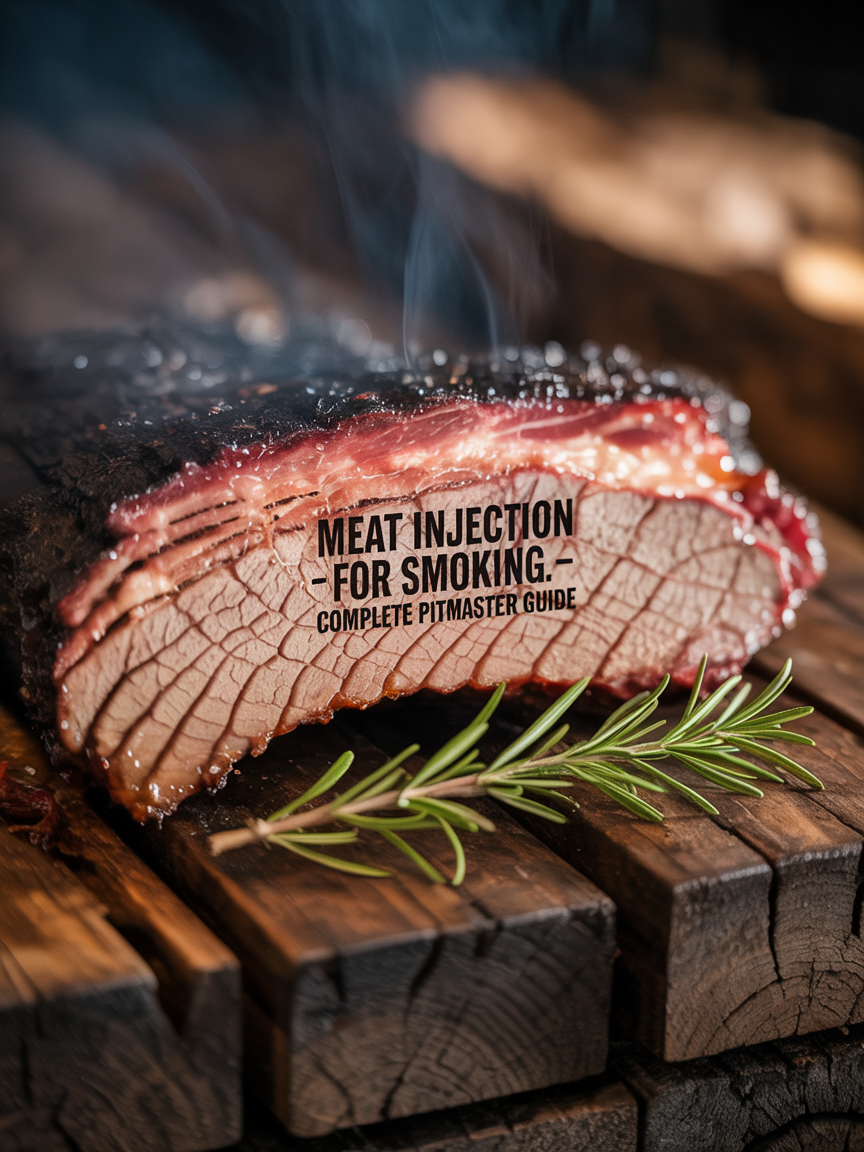
Meat Injection for Smoking: Complete Pitmaster Guide
Ingredients
Method
- Mix your injection liquid the night before or at least 2 hours before your cook. Combine broth, apple juice, Worcestershire sauce, and apple cider vinegar in a small saucepan over low heat. Melt the clarified butter into the liquid and whisk in the kosher salt, garlic powder, onion powder, smoked paprika, and cayenne. Heat gently to around 100 to 110 degrees Fahrenheit, just warm enough to dissolve the salt completely without cooking anything. Whisk vigorously for 60 seconds then pour through a fine mesh strainer into a clean bowl. Let cool to room temperature before injecting so you do not begin any premature cooking of the meat surface. A well-blended injection liquid should be smooth, fragrant, and slightly golden from the butter.
- Prep your pork shoulder by removing it from the refrigerator 30 to 45 minutes before injecting. Pat it completely dry with paper towels and place it fat cap down in a deep roasting pan or injecting tray. This gives you the best access to the thickest muscle groups where injection is most important. Inspect the surface for any silverskin or hard fat deposits and trim them away so your rub and injection can penetrate effectively. A properly trimmed pork butt with a quarter-inch fat cap will render beautifully over a long smoke and give you incredible bark without blocking flavor from getting in.
- Load your injector syringe by submerging the needle tip in the injection liquid and drawing the plunger back slowly until the barrel is full. Tap the side of the barrel gently to release any air bubbles, then depress the plunger slightly to purge any remaining air from the needle tip. For an 8 to 10 pound pork shoulder, you will want to use approximately 1 to 1.5 cups of injection liquid total, working in multiple fill-ups of the syringe. Keep a paper towel ready because the injection liquid will spray and drip as you work through the muscle.
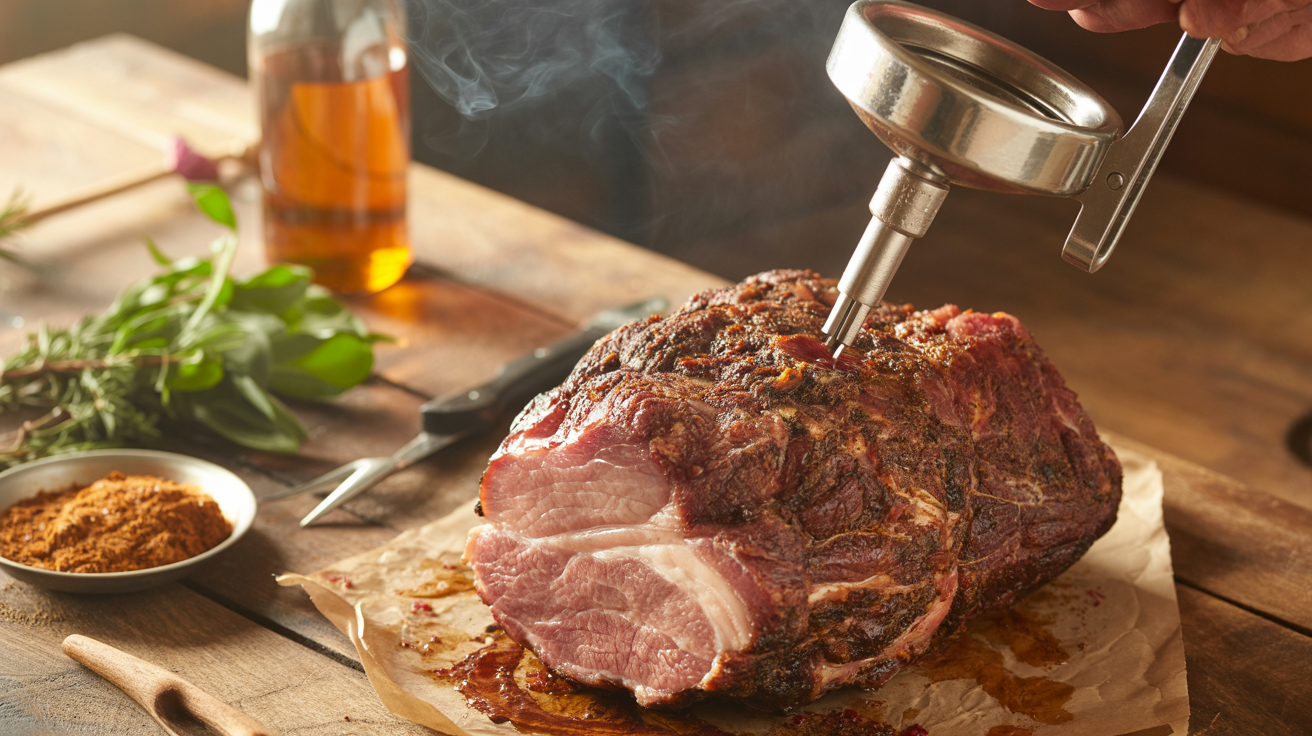
- Begin injecting at the thickest point of the pork shoulder, typically the center of the muscle away from the bone. Insert the needle deep into the meat, going in about 1.5 to 2 inches, and depress the plunger slowly and steadily. You want to inject about 1 ounce of liquid per site. As you slowly withdraw the needle, continue depressing the plunger to distribute liquid along the entire channel you just created. Work in a grid pattern across the surface, spacing each injection site about 1 inch apart in every direction. Rotate the cut and inject from all four sides to ensure complete coverage throughout the entire muscle. You will see the surface swell slightly and liquid may bubble back out of previous holes, which is completely normal.
- Once injection is complete, immediately apply your dry rub. Work the rub into every surface of the pork shoulder with firm pressure, making sure to coat the sides, the bone end, and especially the fat cap. The rub will begin interacting with the surface moisture pulled out by the injection, forming a sticky paste that will later become your bark. Wrap the injected and rubbed pork shoulder in plastic wrap and refrigerate for at least 2 hours, but ideally overnight for up to 12 hours. This rest time allows the injection to distribute more evenly throughout the muscle through osmosis and gives the rub time to form a proper pellicle on the surface.
- Fire up the grill or smoker and bring it to a stable 225 to 250 degrees Fahrenheit before the meat ever goes on. For pork shoulder, we want chunks of oak, hickory, or apple wood for smoke. Give your smoker 30 to 45 minutes to reach temp and stabilize before adding the meat. Pull your pork shoulder from the refrigerator, unwrap it, and allow it to sit at room temperature for 20 to 30 minutes while the smoker comes up to temp. Place the pork shoulder fat cap up directly on the smoker grate, close the lid, and do not open it for at least 3 hours. Maintaining that steady low and slow temperature is what allows the injection to work its magic from the inside while smoke builds bark from the outside.
- Monitor the internal temp using your instant read thermometer, checking every hour after the first 3 hours. Around 165 to 170 degrees Fahrenheit you will hit the stall, where collagen is converting to gelatin and evaporative cooling holds the internal temp steady for sometimes 2 to 3 hours. This is completely normal and not a sign anything is wrong. At this point you can wrap tightly in butcher paper or heavy-duty foil with a splash of apple juice inside the wrap to power through the stall. Return the wrapped pork shoulder to the smoker and continue cooking until the internal temp reaches 195 to 205 degrees Fahrenheit and a probe slides in and out with absolutely zero resistance, like it is going into warm butter.
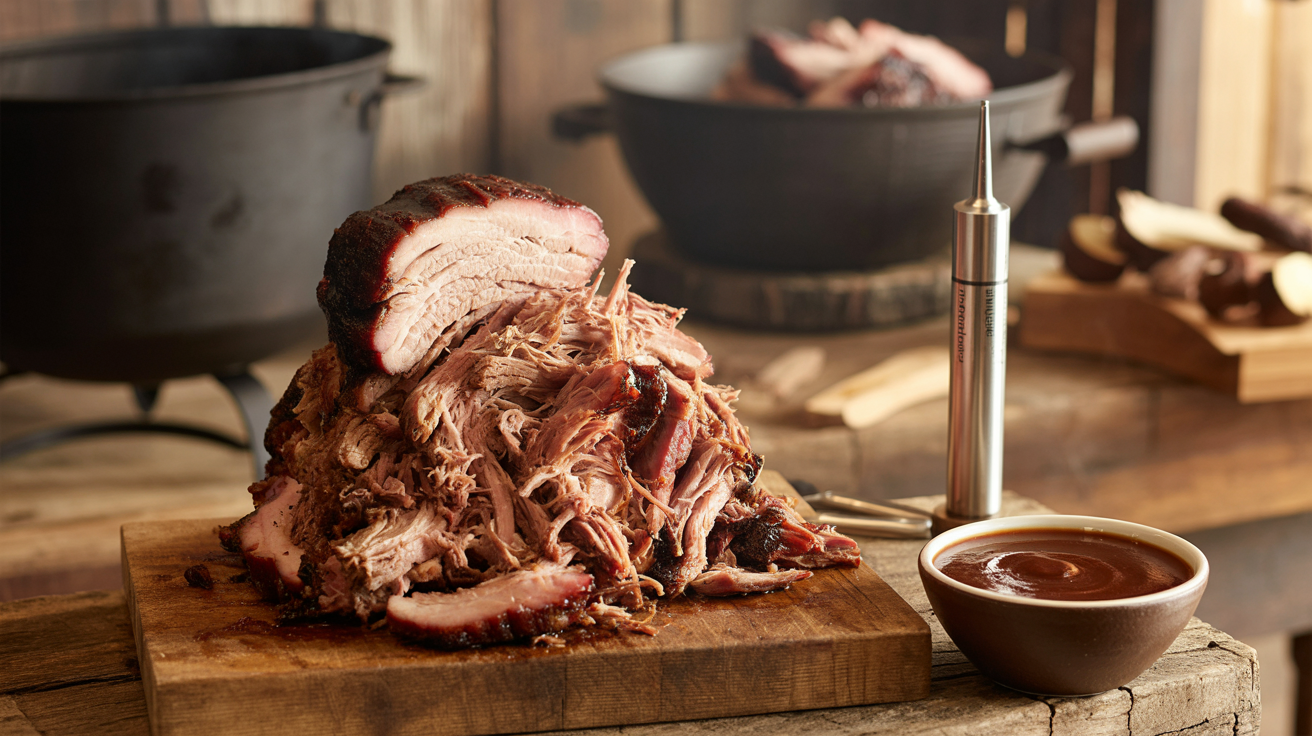
- Once the pork shoulder reaches probe-tender perfection, remove it from the smoker and rest the meat without unwrapping it. Place it in a dry cooler lined with a towel and close the lid. Rest the meat for a minimum of 1 hour and up to 2 hours for the best results. During this rest, the muscle fibers relax and reabsorb all those incredible injected and rendered juices that have been working through the meat during the entire cook. When you finally open that wrap, you will be greeted with a cloud of steam and a pool of deeply flavored jus that you can pour back over the pulled meat when serving. Pull, chop, or slice and serve immediately for peak flavor and texture.
Nutrition
Meat injection for smoking is one of the most underrated techniques in the backyard BBQ playbook, and once you try it, you will never go back to dry, one-dimensional smoked meat again. The idea is simple but powerful: instead of relying solely on rubs and marinades to flavor the surface, you use a meat injector to push seasoned liquid directly into the center of the cut, ensuring every single bite is as juicy and flavorful as the bark on the outside. We are talking about pushing buttery, savory goodness into a 10-pound pork shoulder or a 15-pound whole brisket, places where a dry rub simply cannot reach no matter how long you let it sit.
The real magic happens during that long, low and slow cook. When you fire up the grill or smoker and hold that chamber at 225 to 250 degrees Fahrenheit for 12 to 16 hours, the injected liquid works in concert with the rendered fat and connective tissue breakdown to keep the interior moist and tender. Without injection, large cuts are constantly fighting moisture loss through evaporation off the surface. With a proper injection, you are essentially giving the meat an internal reservoir of flavor and moisture to draw from throughout that entire cook. The result is a smoke ring that runs deep, a bark that is dark and lacquered, and a pull or slice that glistens under the light.
At GrillMasterHQ, we have spent years dialing in injection recipes for everything from competition-style brisket to whole hog, and in this guide we are going to walk you through every step of the process. You will learn which cuts benefit most from injection, how to build a balanced injection recipe, the proper technique for loading and using a meat injector, and exactly when to inject relative to your cook time. Whether you are prepping for a weekend backyard smoke session or heading to your first competition, mastering the meat injection for smoking will level up your entire BBQ game.
Meat Injection for Smoking: Complete Pitmaster Guide
Meat injection for smoking is the secret weapon every serious pitmaster relies on to lock in moisture and drive bold flavor deep into the cut. Learn the exact techniques, injection recipes, and timing tips that transform good BBQ into legendary BBQ. Fire up the smoker today and taste the difference.
Ingredients
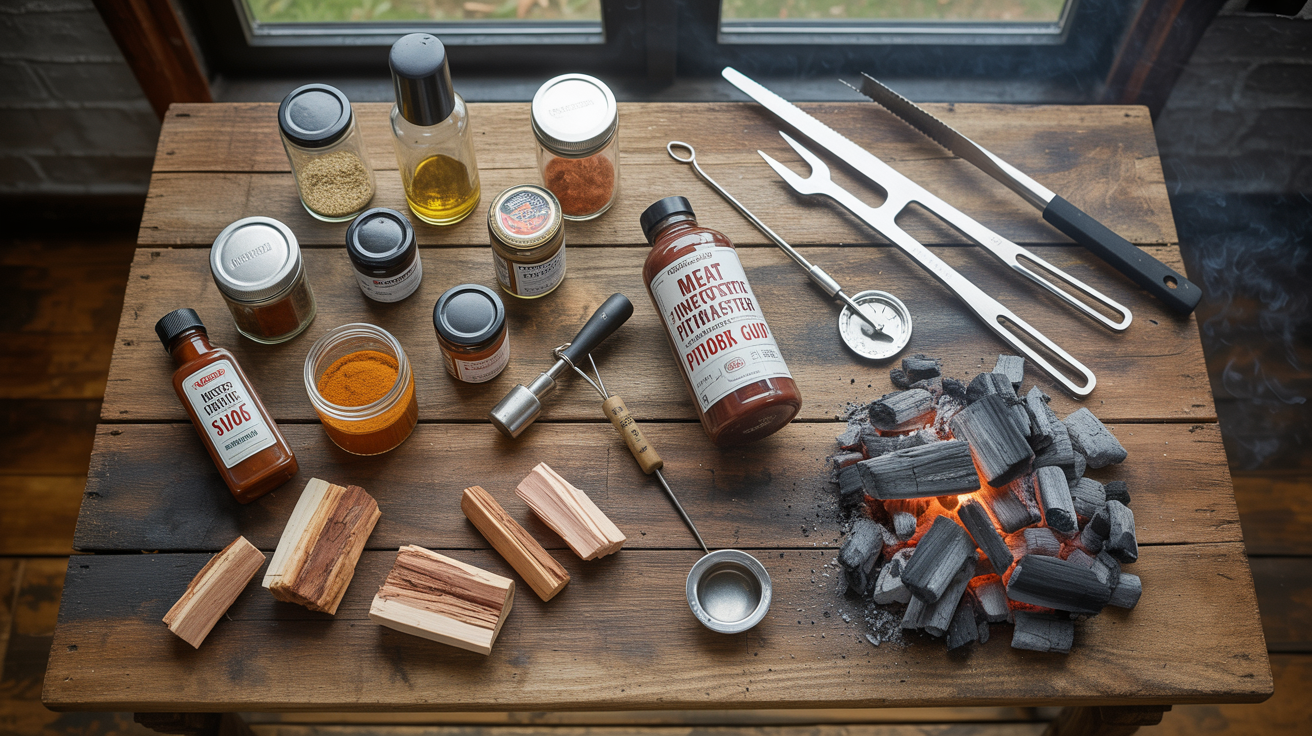
| AMOUNT | INGREDIENT | NOTES |
|---|---|---|
| 8 to 10 | pound bone-in pork shoulder (Boston butt) | fat cap trimmed to about a quarter inch for proper bark formation |
| 1 cup | low sodium beef or chicken broth | use a quality broth with no MSG for the cleanest flavor base |
| 0.5 cup | apple juice | adds natural sweetness and balances the savory injection base |
| 4 tablespoons | unsalted butter | melted and clarified so it flows cleanly through the needle without clogging |
| 2 tablespoons | Worcestershire sauce | adds umami depth and a slightly tangy backbone |
| 1 tablespoon | apple cider vinegar | balances richness and brightens the overall injection profile |
| 1 tablespoon | kosher salt | fully dissolved in the warm liquid before injecting |
| 1 teaspoon | garlic powder | fine grind only so it passes through the needle cleanly |
| 1 teaspoon | onion powder | fine grind, pairs with garlic for a savory aromatic base |
| 1 teaspoon | smoked paprika | adds color and a subtle smoky flavor to the interior of the meat |
| 0.5 teaspoon | cayenne pepper | optional but recommended for a gentle background heat |
| 3 tablespoons | your favorite BBQ rub | for coating the exterior after injection, any coarse rub works |
Instructions
Nutrition (per serving)
The BBQ Story Behind This Recipe
Meat injection as a BBQ technique has deep roots in the competitive BBQ circuit, where winning teams have long understood that surface-level seasoning simply cannot compete with flavor that goes all the way to the bone. The practice gained serious traction in the 1980s and 1990s among pitmasters on the Kansas City and Memphis competition trails, where judges score on taste, texture, and appearance. Teams began experimenting with injecting clarified butter, phosphate solutions, and proprietary spice blends into their pork shoulders and briskets to achieve that over-the-top juiciness that separated a ribbon-winning turn-in box from the rest of the field. Legends of the circuit like Myron Mixon openly credited injection as one of their core winning strategies, and the technique quickly spread from competition tents to backyard smokers across the country.
Regionally, injection takes on different personalities depending on where you are in the BBQ belt. In Texas, where beef brisket is king, injectors are loaded with beef broth, tallow, Worcestershire sauce, and black pepper to amplify the natural beefiness of the cut without masking it. In the Carolinas and Memphis, pork reigns supreme, and injection recipes lean toward apple juice, cider vinegar, brown sugar, and butter to complement the sweet and tangy flavor profiles those regions are famous for. Down in Louisiana and the Gulf Coast, Cajun butter injections packed with garlic, cayenne, and creole seasoning are the standard for everything from whole hog to smoked turkey. No matter which regional style speaks to your soul, the core principle is the same: get flavor inside the meat before it ever hits the smoke.
Hot Off the Grill
A Closer Look
Pitmaster Tips for Best Results
- Always strain your injection liquid through a fine mesh strainer before loading your syringe. Even small particles of undissolved spice or garlic will clog the needle tip and cause frustrating blowouts in the meat surface. A smooth, fully dissolved liquid flows cleanly and distributes evenly every time.
- Inject at room temperature or slightly warmed liquid around 100 degrees Fahrenheit. Cold injection liquid straight from the refrigerator can cause the surrounding muscle to seize and tighten, making even distribution harder and potentially affecting the texture of the finished product.
- Use a grid pattern and inject from multiple angles. Pork shoulders and briskets have distinct muscle groups separated by fat seams, so injecting from only one side will not reach all of them. Work from the top, bottom, and all four sides to saturate every muscle group with your injection liquid.
- Do not inject and cook immediately. Give the injection at least 2 hours in the refrigerator, and ideally 8 to 12 hours overnight, to allow the liquid to migrate through the muscle tissue. The difference between a 2-hour rest and an overnight rest is noticeable in both flavor intensity and moisture distribution across the finished cut.
- For brisket injections, add 1 teaspoon of sodium-free phosphate powder to your liquid if you can find it at a home brew or specialty store. Phosphate is the secret weapon of competition brisket teams because it increases the water-holding capacity of the muscle fibers, giving you that over-the-top juicy slice that holds moisture even after resting and slicing.
🔧 Pitmaster Equipment
Meat Injector Syringe: The core tool for this technique. Choose a heavy-duty stainless steel injector with a capacity of at least 2 ounces and multiple needle tips including a multi-hole needle for even distribution in dense muscles.
Charcoal Smoker or Offset Smoker: Essential for authentic low and slow cooking at 225 to 250 degrees Fahrenheit with proper airflow and smoke management for a genuine smoke ring and bark development.
Instant Read Thermometer: Critical for monitoring internal temp throughout the cook. You are looking for 195 to 205 degrees Fahrenheit in pork and brisket for true probe-tender results.
Large Mixing Bowl and Fine Mesh Strainer: Mix and strain your injection liquid before loading the syringe. Any undissolved particles will clog the needle and make the injection process frustrating and uneven.
Food-Safe Injecting Pan or Tray: Place the meat in a deep pan while injecting to catch runoff and prevent cross-contamination on your work surface.
Nitrile Gloves: Keep things sanitary when handling raw meat and injecting. Gloves also protect your hands from any hot marinade if you inject while the meat is still slightly warm from a brine.
Butcher Paper or Heavy-Duty Aluminum Foil: Used for the Texas crutch wrap method once the bark is set, typically around 165 to 170 degrees Fahrenheit internal temp, to push through the stall efficiently.
🔥 Variations
Texas-Style Beef Brisket Injection: For a whole packer brisket, build your injection around 1 cup of beef broth, 4 tablespoons of melted tallow or unsalted butter, 2 tablespoons of Worcestershire sauce, 1 tablespoon of soy sauce, 1 teaspoon of coarsely ground black pepper, and 1 teaspoon of kosher salt. Keep it simple and beef-forward to honor the Texas tradition. Inject the flat and the point separately with the same grid technique and let the brisket rest overnight before a 12 to 16 hour smoke at 225 degrees Fahrenheit over post oak.
Cajun Butter Turkey Injection: Melt 1 full stick of unsalted butter and blend it with 2 tablespoons of hot sauce, 1 tablespoon of Cajun seasoning, 1 teaspoon of garlic powder, 1 teaspoon of onion powder, and a quarter teaspoon of white pepper. Inject the breast meat deeply and then work the needle into the thighs and drumsticks. Let the bird rest refrigerated for 4 to 6 hours before smoking at 275 degrees Fahrenheit until the breast reads 165 degrees Fahrenheit internal temp. The butter injection keeps turkey breast from drying out during the smoke.
Competition Pork Ribs Injection: While ribs are thinner than pork shoulder and cannot hold as much liquid, a subtle injection still makes a difference in competition settings. Mix half a cup of apple juice, 2 tablespoons of honey, 1 tablespoon of butter, and a pinch of salt. Use a thin single-hole needle and inject between each bone from the meat side before applying your rub. The injection adds sweetness and moisture to the interior of the rack without over-saturating the thin meat, giving you that glass-like glaze and tender bite that competition judges love.
Pellet Grill Version: Set your pellet grill to 225 degrees Fahrenheit and load it with hickory or apple pellets. Follow the exact same injection process and timing, and use the same grid pattern technique. Pellet grills run very consistent temps which makes them ideal for long low and slow cooks. You may find the bark development is slightly lighter than an offset smoker due to the cleaner burn, so consider adding a smoke tube loaded with wood chips for the first 3 to 4 hours of the cook to increase smoke output and drive that bark development.
Gas Grill Version: Set up your gas grill for indirect heat by lighting only one or two burners on one side and placing the injected meat on the unlit side. Use a smoker box filled with soaked hickory or apple wood chips positioned over a lit burner. Maintain a grill temperature of 250 degrees Fahrenheit by adjusting your burner controls. The injection is even more critical on a gas grill because the smoke flavor is lighter than an offset or charcoal setup, so the internal flavor from the injection carries more of the overall flavor profile of the finished meat.
❓ Pitmaster FAQ
What internal temperature should pork shoulder reach when smoking?
For pulled pork, you are targeting an internal temp between 195 and 205 degrees Fahrenheit. At that range the collagen has fully converted to gelatin and the muscle fibers will pull apart effortlessly. Do not just go by temperature alone though. Always do the probe test with your instant read thermometer and make sure it slides into the thickest part of the meat with zero resistance before you pull it off the smoker.
How far in advance should I inject meat before smoking?
The minimum is 2 hours before the cook, but the sweet spot is an overnight injection rest of 8 to 12 hours in the refrigerator. The extra time allows the injection liquid to migrate through the muscle tissue via osmosis, giving you more even flavor and moisture distribution throughout the entire cut. When you inject and cook immediately, the liquid tends to stay concentrated around the injection sites rather than spreading through the whole muscle.
Can I use the same injection recipe for different cuts of meat?
You can use a universal base of broth, butter, and salt for almost any cut, but the best results come from tailoring the injection to the protein. Beef brisket does best with beef-forward flavors like tallow, Worcestershire, and black pepper. Pork shoulder shines with apple juice, cider vinegar, and a touch of sweetness. Turkey and chicken love butter-based injections with garlic and herbs. The base technique is the same across all cuts, but matching the flavor profile to the protein makes a noticeable difference in the final result.
My injection liquid keeps leaking out of the holes. What am I doing wrong?
Some blowback is completely normal, especially on cuts like pork shoulder that have dense, tight muscle fibers. If you are getting excessive leakage, you are most likely injecting too fast. Slow your plunger pressure way down and inject steadily over 5 to 7 seconds per site. Also make sure you are withdrawing the needle slowly while still depressing the plunger, which deposits liquid along the entire channel rather than creating a single pressurized pocket that forces liquid back out. Resting the meat in the refrigerator after injection also helps the liquid absorb rather than bleed out.
Do I still need a dry rub if I am injecting the meat?
Absolutely yes. Injection and dry rub serve completely different purposes and they work together, not in place of each other. Injection handles interior moisture and flavor while the dry rub is responsible for forming the bark on the exterior surface. That dark, lacquered, deeply flavored bark is one of the defining characteristics of great smoked meat and it can only come from a properly applied rub that has had time to interact with the meat surface before and during the cook. Skip the rub and you will have juicy but pale, underdeveloped exterior texture on your finished product.
Is a more expensive injector worth the money?
Yes, and significantly so. Cheap plastic injectors with thin needles clog constantly, crack under pressure, and are nearly impossible to fully clean between uses, which is a food safety concern. A heavy-duty stainless steel injector with a 2 to 3 ounce barrel, a locking plunger, and a set of interchangeable needle tips including a multi-hole dispersal needle is a worthwhile investment that will last years. The multi-hole needle in particular is a game changer because it disperses the liquid in multiple directions simultaneously, reducing blowback and dramatically improving coverage with fewer injection sites.