
Pork Belly Burnt Ends Recipe: Smoky BBQ Candy
Ingredients
Method
- Fire up your smoker and bring it to a steady 250 degrees Fahrenheit. Use charcoal as your heat source and add two to three fist-sized chunks of cherry or applewood directly onto the coals. You want thin blue smoke rolling out of the exhaust vent, not thick white billowing smoke. Thick white smoke will make your meat taste bitter. Give the smoker 20 to 30 minutes to stabilize at temperature before you load anything onto the grates.
- While the smoker comes up to temp, prepare your pork belly. Pat the slab completely dry with paper towels on all sides. Moisture is the enemy of good bark. Coat the entire surface with a thin, even layer of yellow mustard. This acts as a binder and you will not taste it at all in the final product, it just helps the rub adhere.
- Combine the brown sugar, smoked paprika, kosher salt, black pepper, garlic powder, onion powder, cayenne, and chili powder in a small bowl and mix thoroughly. Apply a generous, even coating of this rub to all six sides of the pork belly slab, pressing it gently into the mustard so it adheres well. Do not be shy with the rub. A thick crust is what builds that legendary bark.
- Place the seasoned pork belly slab fat side up on a wire rack set inside your smoker. Fat side up allows the rendering fat to baste the meat as it cooks. Close the lid and let the smoke do its work. Do not open the smoker for at least 90 minutes. Every time you lift the lid you are adding time to your cook. Trust the process.
- Monitor your smoker temperature throughout the cook, keeping it between 245 and 260 degrees Fahrenheit. Add additional wood chunks as needed to maintain smoke production during the first two hours. After that point the meat will have absorbed most of the smoke it is going to take on and you can let the coals carry the heat. Check the color of the bark around the two and a half hour mark. You are looking for a deep reddish-brown mahogany crust that looks firm and set.
- At the three hour mark, insert your instant read thermometer into the thickest part of the pork belly. You are targeting an internal temp of 190 to 195 degrees Fahrenheit for the initial smoke phase. The bark should be fully set, deep in color, and the surface should feel firm to a gentle press. If you are not there yet, keep the lid shut and check again every 20 minutes.
- Once the pork belly hits 190 to 195 degrees Fahrenheit internally and the bark looks right, pull it off the smoker and let it rest on a cutting board for 15 minutes. This rest allows the juices to redistribute before you start cutting. Do not skip this step. After resting, slice the slab into 1.5-inch cubes using a sharp knife. Try to keep the pieces as uniform as possible so they cook evenly in the next phase.
- Transfer all the cubed pork belly pieces into a heavy duty aluminum foil pan in a single layer. Add the cubed butter, honey, apple cider vinegar, and BBQ sauce directly over the top of the cubes. Use tongs to gently toss everything together until each cube is coated. The pan should look glossy and saucy but not swimming in liquid.
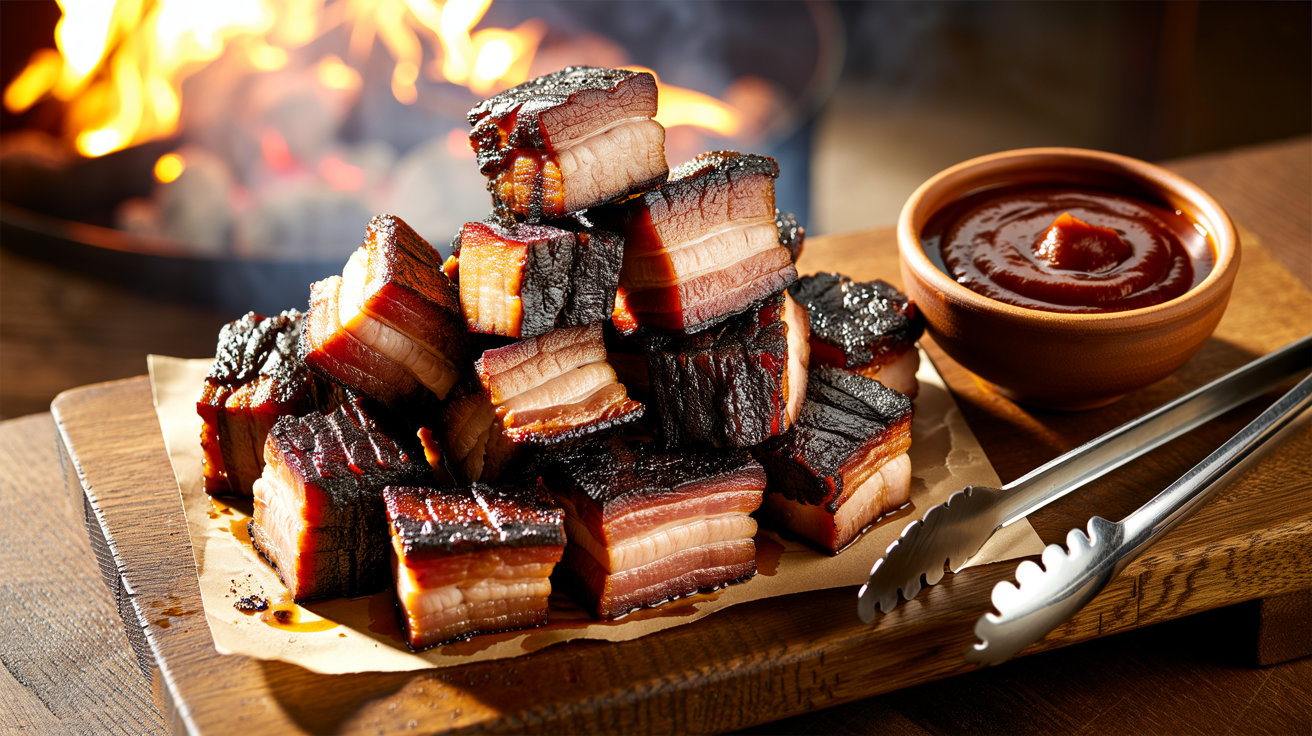
- Return the uncovered foil pan to the smoker at 250 degrees Fahrenheit. Cook for another 60 to 90 minutes, tossing the cubes gently with tongs every 30 minutes. You are watching for the sauce to reduce and caramelize around each cube, creating that sticky, lacquered coating that defines the perfect burnt end. The cubes should look shiny, deeply colored, and slightly tacky to the touch.
- For the final 15 minutes of the cook, you can crank the smoker up to 275 degrees Fahrenheit to help tighten up the glaze and add a little more caramelization. This is optional but highly recommended if you want that extra sticky exterior. Pull the pan when the sauce has reduced to a thick glaze and each cube looks lacquered and irresistible. Remove the pan from the smoker and let the burnt ends rest uncovered for 10 minutes before serving. This short rest lets the glaze set up even more. Serve immediately and get ready for the most requested dish at your next cookout.
Nutrition
This pork belly burnt ends recipe is the holy grail of backyard BBQ, producing impossibly tender, caramelized cubes of smoked pork that every pitmaster dreams about. We are talking deep mahogany bark on the outside, a gorgeous smoke ring just beneath the surface, and a soft, buttery interior that practically dissolves the moment it hits your tongue. If you have never made these before, clear your Saturday schedule right now because this cook is going to change the way you think about BBQ forever.
We run this cook at 250 degrees Fahrenheit for the first phase, letting the pork belly sit in the smoke for around three hours until the bark sets up and the internal temp climbs into the 190 degree range. Then we cube it, sauce it, butter it, and send it back into the smoker in a foil pan for another 60 to 90 minutes of pure magic. The result is what the BBQ community affectionately calls meat candy, and once you taste it, you will completely understand why these little bites have become the most requested item at every backyard cookout.
Cherry or applewood are our go-to wood choices here at GrillMasterHQ because they deliver a sweet, mild smoke that complements the rich fat content of the pork belly without overpowering it. Hickory works too if you prefer a bolder smoke profile. The key to this entire cook is patience. Do not rush the process, trust your thermometer over the clock, and let the fire do what it does best. Low and slow is not just a philosophy here, it is the only path to burnt end perfection.
Pork Belly Burnt Ends Recipe: Smoky BBQ Candy
This pork belly burnt ends recipe delivers caramelized, smoky BBQ candy that melts in your mouth with every single bite. Low and slow smoke, a sticky glaze, and perfect bark make these irresistible. Fire up the smoker today and treat yourself to the best bites in BBQ.
Ingredients
| AMOUNT | INGREDIENT | NOTES |
|---|---|---|
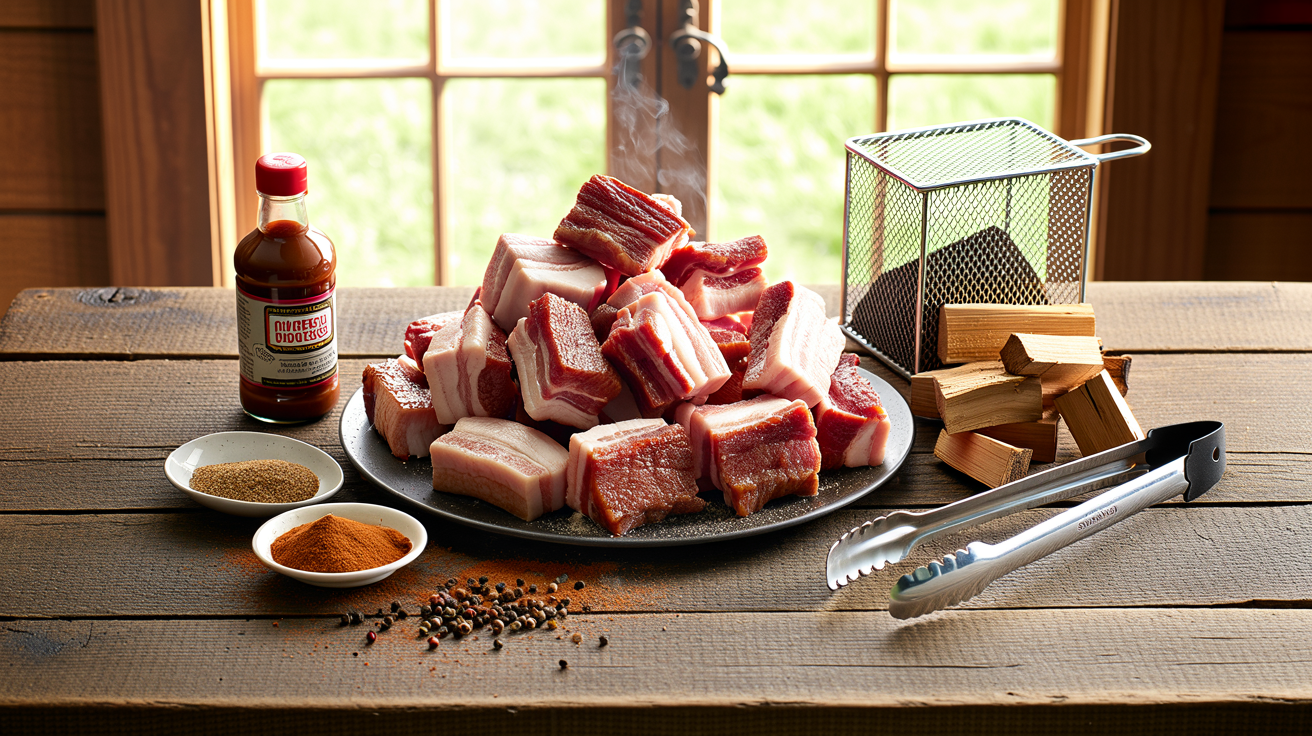
| 3 lbs | skinless pork belly slab | look for even thickness throughout for consistent cooking |
| 3 tablespoons | yellow mustard | acts as a binder to help the rub stick |
| 3 tablespoons | brown sugar | packed, for the rub base |
| 2 tablespoons | smoked paprika | adds color and smoky depth to the bark |
| 1 tablespoon | kosher salt | coarse grain preferred |
| 1 tablespoon | black pepper | freshly cracked for best flavor |
| 1 teaspoon | garlic powder | |
| 1 teaspoon | onion powder | |
| 0.5 teaspoon | cayenne pepper | adjust up or down to your heat preference |
| 0.5 teaspoon | chili powder | |
| 4 tablespoons | unsalted butter | cubed, used in the final braising phase |
| 0.5 cup | your favorite BBQ sauce | a sweet Kansas City style sauce works best here |
| 3 tablespoons | honey | adds gloss and extra caramelization in the final phase |
| 2 tablespoons | apple cider vinegar | balances the sweetness and adds brightness |
| 3 chunks | cherry or applewood chunks | for smoke, not chips – chunks burn longer and more evenly |
Instructions
Nutrition (per serving)
The BBQ Story Behind This Recipe
Burnt ends have deep roots in Kansas City BBQ culture, originally born out of practicality rather than intention. When pitmasters at legendary joints like Arthur Bryant’s and Gates Bar-B-Q would smoke whole briskets, the pointed flat end would cook faster and develop an intensely flavored, crusty outer layer. Those irregular, overly charred edge pieces were trimmed off and either discarded or tossed into a bin near the counter for customers to snack on for free while they waited in line. Over time, regulars began specifically requesting those rough, caramelized trimmings, and burnt ends evolved from a throwaway byproduct into the most coveted item on the menu.
Pork belly burnt ends are a more modern evolution of the original brisket burnt end tradition, rising to widespread popularity in the late 2010s as backyard pitmasters and competition BBQ teams began experimenting beyond beef. Pork belly, with its extraordinary fat-to-meat ratio, turned out to be an absolutely ideal candidate for the burnt end treatment. The heavy fat content renders down beautifully during the long smoke, basting the meat from within and creating a texture that many argue surpasses even the best brisket burnt ends. Today, pork belly burnt ends appear on competition BBQ circuits, high-end BBQ restaurants, and backyard smokers from coast to coast, cementing their place as a true American BBQ icon.
Hot Off the Grill
A Closer Look
Pitmaster Tips for Best Results
- Always start with a skinless pork belly for burnt ends. The skin does not render properly during the cook and will result in a chewy, rubbery layer that ruins the texture. Ask your butcher to remove it if the slab comes with skin on.
- Keep your smoker temperature as steady as possible between 245 and 260 degrees Fahrenheit throughout the entire cook. Wild temperature swings extend cook time and can cause uneven bark development. Invest in a quality dual-probe wireless thermometer to monitor both the pit temp and the meat internal temp simultaneously.
- Thin blue smoke is your best friend and thick white smoke is your enemy. If your smoker is producing heavy white smoke, open the vents slightly to increase airflow and allow the wood to combust more completely. Bitter white smoke will penetrate the meat and create an unpleasant acrid flavor no amount of sauce can mask.
- Do not sauce the burnt ends too early in the braising phase. Adding BBQ sauce to the foil pan when the temp is too low will result in a soupy, watery finish rather than a sticky glaze. The smoker needs to be at a full 250 degrees Fahrenheit when the pan goes back on so the liquid reduces properly.
- The pork belly is fully done in the final phase when a toothpick or skewer slides into the center of each cube with absolutely zero resistance, like pushing it into warm butter. If there is any resistance at all, give the pan another 20 minutes. Internal temp at this stage will typically be in the 205 to 210 degree Fahrenheit range.
🔧 Pitmaster Equipment
Charcoal Smoker or Offset Smoker: Delivers authentic wood smoke flavor and gives you precise control over airflow and heat for a proper low and slow cook.
Instant Read Thermometer: Critical for monitoring internal temp accurately throughout the cook. Do not guess when you can know exactly where your meat stands.
Wireless Probe Thermometer: Lets you monitor the internal temp of the pork belly without lifting the lid and losing precious heat and smoke.
Heavy Duty Aluminum Foil Pan: Used in the final braising phase to hold the cubed pork belly with butter and sauce, creating the sticky glaze that defines burnt ends.
Long Tongs or Heat Resistant Gloves: Keep your hands safe while managing the fire, adjusting wood chunks, and handling the hot foil pan.
Sharp Boning or Chef Knife: Needed to cube the smoked pork belly into uniform 1.5-inch pieces so every bite cooks evenly in the final phase.
Wire Cooling Rack: Elevates the pork belly slab in the smoker, allowing smoke to circulate fully around all sides for even bark development.
🔥 Variations
Pellet Grill Version: Set your pellet grill to 250 degrees Fahrenheit and load the hopper with cherry or apple pellets for a sweet smoke profile. Follow every step exactly as written. Pellet grills run very consistently so temperature management is largely hands-off, making this an excellent set-it-and-monitor-it cook for newer pitmasters.
Gas Grill Version: Set up your gas grill for two-zone indirect cooking by lighting only one side of the burners and targeting 250 degrees Fahrenheit on the cool side. Place a smoker box loaded with soaked cherry wood chips directly over the lit burner. Position the pork belly over the unlit side and follow the same timing and temp guidelines. You may need to replenish the wood chips every 45 to 60 minutes to maintain smoke throughout the cook.
Spicy Korean-Inspired Burnt Ends: Swap the standard BBQ sauce in the braising phase for a mixture of gochujang paste, soy sauce, sesame oil, honey, and rice vinegar. The result is a sweet, fiery, umami-packed glaze that takes these burnt ends in a completely different but equally incredible direction. Garnish with sesame seeds and sliced scallions before serving.
Competition Style Butter Bath: For an over-the-top rich finish, double the butter in the foil pan and add a quarter cup of brown sugar along with the BBQ sauce. This creates an incredibly indulgent, candy-like coating that competition BBQ teams use to win over judges. It is pure decadence and absolutely worth every calorie at a special occasion cookout.
❓ Pitmaster FAQ
What internal temperature should pork belly burnt ends reach?
In the initial smoke phase you are targeting 190 to 195 degrees Fahrenheit before cubing. In the final braising phase in the foil pan, the burnt ends will typically climb to 205 to 210 degrees Fahrenheit, which is the sweet spot where all that collagen and fat has fully rendered and the texture becomes melt-in-your-mouth tender. Always use a calibrated instant read thermometer to verify internal temp.
How long does it take to smoke pork belly burnt ends?
Plan on a total cook time of 4.5 to 5.5 hours from start to finish at 250 degrees Fahrenheit. The initial smoke phase takes approximately 3 hours, followed by 60 to 90 minutes in the foil pan braising phase. Always cook to internal temp rather than the clock since every piece of pork belly and every smoker behaves slightly differently.
Can I use a pork belly with the skin on?
We strongly recommend removing the skin before cooking for burnt ends. The thick rind does not render down during the cook the same way the fat does, and it ends up chewy and tough rather than tender. Most grocery stores and warehouse clubs sell skinless pork belly slabs, and any butcher will remove the skin for you upon request.
What is the best wood for smoking pork belly burnt ends?
Cherry and applewood are our top recommendations at GrillMasterHQ because their mild, sweet smoke profiles complement the rich fat content of the pork belly without overwhelming it. Pecan is another excellent option that adds a slightly nuttier flavor. Hickory works well if you prefer a bolder, more traditional BBQ smoke flavor. Avoid mesquite for this cook as it is too aggressive for a 4 to 5 hour smoke and can turn bitter.
Can I make pork belly burnt ends ahead of time?
Yes, and they actually reheat beautifully. Store fully cooked burnt ends in an airtight container in the refrigerator for up to four days. To reheat, place them back in a foil pan with a splash of BBQ sauce and a tablespoon of butter, cover with foil, and warm in a 300 degree Fahrenheit oven or smoker for 20 to 25 minutes until heated through. The glaze will reconstitute and they will taste almost as good as fresh off the smoker.
Why do my burnt ends turn out tough instead of tender?
Toughness almost always means the pork belly did not reach a high enough internal temp or did not spend enough time in the braising phase. Collagen and connective tissue in pork belly break down between 195 and 210 degrees Fahrenheit. If you pull the meat too early, that collagen has not fully converted to gelatin and the texture stays tight and chewy. Trust your thermometer, not the clock, and give the braising phase adequate time to do its job.